
Low Rates or Real Leverage? Right Now, It's Leverage
Low Rates or Real Leverage? Right Now, It's Leverage
If you've been checking mortgage rates every morning like it's the weather forecast, hoping for a break in the clouds, you're not alone. Rates pushed past 7% this year, and plenty of buyers decided to hit pause.
But here's what the rate headlines leave out: buyers almost never get low rates and real negotiating power at the same time. It's usually one or the other.
And right now? You've got a lot more of that second one than you might think.
Remember 2021? Great Rates, Zero Leverage
Rates hovered around 3%, and it felt like everyone and their cousin was house hunting. The catch: there weren't nearly enough homes to go around.
So we all lived through it:
- Bidding wars on just about everything
- Offers way over asking
- Buyers waiving inspections just to stay in the running
Sellers held every card. According to Realtor.com, seller's markets peaked in spring 2022 in 98 of the country's 100 largest metros. Cheap money, sure. But buyers paid for it in other ways.
Then the Pendulum Swung
In the back half of 2022, rates started climbing. Fewer people bought, more homes sat on the market, and the balance of power slowly tipped back toward buyers.
That shift isn't a prediction anymore. It's here. Realtor.com's latest report found that 66 of the top 100 metros now lean in buyers' favor. That's a complete flip from where we were just a few years ago.
What Your Leverage Actually Looks Like
There are more homes for sale than we've seen in years, and they're taking longer to sell. Lawrence Yun, Chief Economist at the National Association of Realtors, points to exactly that combo as the reason buyers have more negotiating power today.
Here's where it gets real: Redfin reports that nearly half of buyers are now getting some kind of concession from the seller. That can look like:
- Help covering closing costs
- A credit for repairs
- The seller paying to buy down your mortgage rate
That last one is a big deal. So if you find a home you love and the rate isn't what you'd hoped, don't stop at the rate. Ask about a price adjustment or a seller-paid buydown. There are more levers to pull than most buyers realize.
Why Waiting It Out Could Backfire
If your plan is to sit tight until rates drop, here's the reality check. Forecasters at Fannie Mae, the Mortgage Bankers Association, and Wells Fargo aren't expecting much relief through 2027.
And even if rates did fall in a big way? All those buyers on the sidelines would rush right back in. More competition means fewer concessions, fewer deals, and sellers back in the driver's seat.
So waiting is a trade. You might snag a better rate later, but you'd likely give up the bargaining power you have today.
To be clear: you should only buy when the numbers work for you. But if you have a real reason to move, today's leverage might be exactly what makes those numbers work.
What This Means Here in Middlesex County
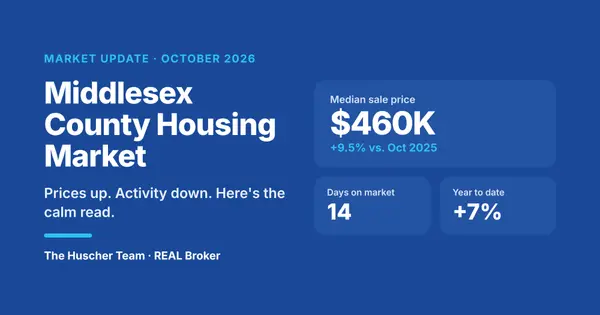
Here's the honest local picture: Middlesex County is still competitive. Homes have sold for about 2% over asking on average this year, and with roughly two months of supply, the market technically still leans toward sellers.
But look a little closer and the leverage is building:
- Buyers are pulling back. New pending sales in October were down 40% from last year.
- Homes are sitting longer. Median days on market hit 13 in October, nearly double the 7 days we saw this spring.
- The bidding is cooling. Homes closed about 3.9% over asking in May. By October, it was barely 1%.
- Price cuts are common. Nearly a third of active listings (119 of 386) have already dropped their price, by an average of 9%.
Translation? The spring frenzy is over, and the homes that have been sitting are where your leverage lives. Some listings still draw a crowd the first weekend. Others have had a price cut or two, and those sellers are often open to talking about closing costs, repairs, or a rate buydown. Knowing which is which (and how to ask) is where local experience pays off.
Not Every Price Point Gets the Same Deal
Here's the twist: Middlesex County is really two markets right now, and your leverage depends a lot on your price range.
$200K–$399K: 1.4 months of supply · 11 days on market · about 2% over asking
$400K–$599K: 1.5 months of supply · 8 days on market · about 4% over asking
$600K–$799K: 3.4 months of supply · 10 days on market · about 2% over asking
$800K–$999K: 4.3 months of supply · 16 days on market · about 3% over asking
$1M+: 3.5–10 months of supply · 4–73 days on market · mostly under asking
Recent sales, Jul 12 – Nov 9, 2026. Supply as of Nov 9. Source: SmartMLS.
Under $600K, it's still a seller's market. With less than two months of inventory, the best homes in that range still draw multiple offers. Buyers there need a sharp strategy to win, not just a low offer.
Over $1 million, buyers have real room to negotiate. More homes to choose from, longer days on market, and many sales closing below list price.
So before you decide whether to wait or move, the real question isn't "what's the market doing?" It's "what's my price point doing?"
Source: SmartMLS Market Snapshot, Middlesex County, as of Nov 9, 2026.
The Bottom Line
You rarely get low rates and strong negotiating power at the same time. Today's market is handing buyers the leverage, and that's worth something.
If you're curious whether it could work for your budget, let's talk. We'll walk through which homes might have room for a rate buydown or closing cost help, and what your numbers would really look like. No pressure, just a clear picture.
The Huscher Team (Debbie Huscher & Tanya Bottaro) | REAL Broker Debbie 860-918-4580 · Tanya 203-687-7194
Life Moves Deserve Local Expertise.
Categories
Recent Posts








The Huscher Team at REAL
Phone